
Latest Instagram Photos


       
|
|||||||||||||||||||||||||||
|
|
|||||||||||||||||||||||||||

Thursday, May 03, 2018
You Don't Have to Burn A (Wild Horse) Book to Censor It I've never laid my life on the line for a story, and it's coincidence that the most recent "Of course you didn't interview BLM about wild horses" remark came on World Press Freedom Day. The reader was talking about Wild at Heart: Mustangs and the Young People Fighting to Save Them, my non-fiction book published by Houghton-Mifflin-Harcourt. The book's credibility has been honored without BLM. It's a Junior Library Guild selection, winner of the Sterling North Heritage award for Excellence in Children's Literature and has been honored by Western Writers of America, National Science Teachers Association and American Association for the Advancement of Science. For nearly a year, I negotiated and nagged for interviews about BLM's wild horse and burro program. Didn't happen. But it's important to me that you see how it didn't happen. My last correspondence before the publication of this book is posted below. 
Tom
Gorey, Senior Public Affairs Specialist July
23, 2014
Bureau
of Land Management
1849
C. Street NW
Washington,
D.C. 20240
Dear Tom,
As you know, I’m writing Wild at Heart:
Mustangs and the Young People Fighting to Save Them for
Houghton-Mifflin-Harcourt. This non-fiction book for young readers will be
published in Fall 2015.
In January of this year, Lisa Ross at
BLM’s Carson City office told me that all on-the-record responses must go
through you. I’ve contacted many BLM staffers since then, but received no
official statements. A partial list:
1/23/14: E-mail to
Tom Gorey, introducing project, asking for interview; he said he’d have to
check with wild horse and burro staff.
2/3/14: E-mail to Gorey
seeking update
2/4/14: E-mail from Gorey
indicating response is in the works; e-mail from Jeff Krauss asking for
questions in writing and “don’t hesitate to call” invitation
2/11/14: E-mail
questions to Krauss
2/19/14: E-mail
requesting update from Krauss
2/24/14: Melissa
Farlow, photojournalist working on the project, contacts Krauss since they’ve worked
together in past. Krauss responds
quickly but with no answers.
3/19/14: E-mail to
Krauss requesting follow-up to written questions
4/11/14: E-mail and
phone requests to Gorey and Krauss repeating offer to let them cherry-pick the
questions they wish to answer.
4/25/14: Phone calls
to former BLM staffers to ask about possible sources of information are met with enthusiasm. They, too, are told no current
staffers are authorized to speak.
5/5/14: Phone and e-mail
to Jeff Fontana, BLM California, and Lisa Reid, BLM Utah. Neither receives
authorization to answer questions.
5/5/14: Gorey e-mails
that he will respond to my voicemail request for update, copies Krauss. No
answers. Last contact with Gorey and Krauss
6/3-4/14: After phone
conversations, Debbie Collins asks for a brief history of e-mail exchanges with
BLM staff and list of questions. These are supplied. Last contact with Collins.
6/4/14: Fontana e-mails positive BLM news story from
2006. Last contact.
My publisher has pushed back Wild at Heart’s due date to give BLM more time to respond, but we’ve bent as far as we can. If I hear nothing by Aug. 1, 2014, we’ll reluctantly publish without comments from your agency.
Sincerely,
Terri Farley
CC: Neil Kornze, Director of
BLM
Before Wild At Heart, I'd had a conflicted but cordial relationship with BLM staffers, but now it's routine for government agencies to spurn or stonewall the press and public. That's not safe. Attention must be paid, even if what you hear is silence. Labels: BLM, Bureau of Land Management, Houghton Mifflin Harcourt, Junior Library Guild, mustangs, National ScienceTeachers Association, Western Writers of America, Wild at Heart, wild horses, World Press Freedom Day Permalink to this blog post Posted by Terri Farley @ 12:50 PM 0 comments  

Sunday, October 22, 2017 Wild Horses Are Not an Invasive Species New Science, Old Bones and Wild Horses"It needs to be more widely understood that the horse's status as a native North American species is beyond serious question, " Dr. Ross MacPhee, curator American Museum of Natural History
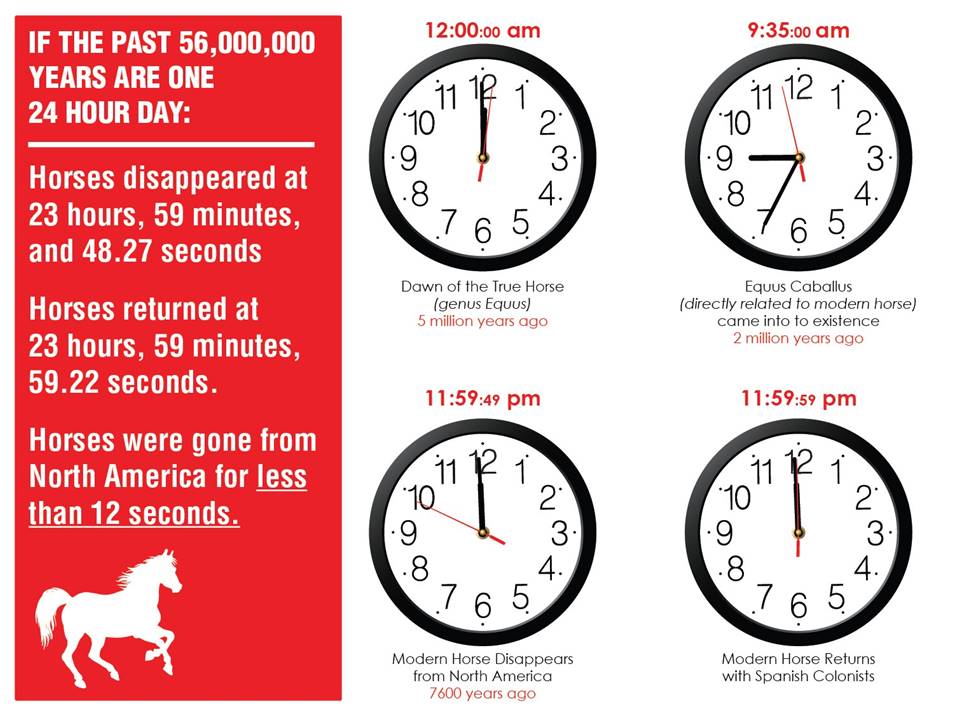 ©Terri FarleyCREATED FOR WILD AT HEART: MUSTANGS AND THE YOUNG PEOPLE FIGHTING TO SAVE THEMModern paleontology and sequencing of mitochondrial DNA is reflected in this equine clock which shows just how quickly horses returned to North America after they were wiped out along with other large mammals. Recent discoveries have narrowed the absence window since this graphic was created, causing many scientists to consider the possibility that pockets of North American horses may have survived even longer.Labels: American Museum of Natural History, DNA, Dr. Ross MacPhee, equine, horses, mustangs, native species, paleontology, science, wild horses Permalink to this blog post Posted by Terri Farley @ 2:52 PM 0 comments
Thursday, August 24, 2017 DEAR MR. PRESIDENT: WE'RE WILD HORSES. WHY DO YOU WANT TO KILL US? Dear Mr. President,We’re wild horses. Born in Nevada, we ran free on the range, manes blowing, legs reaching and pulling us up mountains and then downhill in crazy gallops, zig-zagging through storm-hammered sage brush.We’re not there anymore. We’re in a place called BLM. We’re young, healthy and we play chase when we can.So, when we heard you wanted to kill us -- not as the cougar does, one at a time to feed her young, but all together, for reasons we don’t understand --we asked a friend to speak for us in your language.Thank you, sir, The Mustangs
please turn on audio
Labels: BLM, cougar, gallop, Mr. President, Palomino Valley, sage brush, wild horses Permalink to this blog post Posted by Terri Farley @ 6:56 PM 0 comments
Tuesday, June 20, 2017 Interior Department Wants to Bury Its Wild Horse Mistakes: question Sec. Zinke's alt-facts tomorrow Dear Legislator, Don't be hoodwinked when Department of Interior Secretary Ryan Zinke comes to Capitol Hill, tomorrow. For decades, the Department of Interior has taken America's wild horses off public lands to "restore the range." Know why that doesn't work? Wild horses aren't to blame, but Secretary Zinke may neglect to mention the impacts of livestock and extractive industries on the environment. Budget 2018 calls for killing all wild horses and burros in Bureau of Land Management holding pens. That's about 44,000 equines according to BLM, and the roundups continue, this month. BLM records show more mustangs "gathered" in the first three months of 2017 than were captured in all of 2016. Few voters want wild horses killed, but they’re bombarded by myths which infer there's no choice. Permalink to this blog post Posted by Terri Farley @ 11:59 AM 0 comments
Tuesday, May 30, 2017 5 WILD HORSE MYTHS: Alt-Facts Lead to Deadly New Budget for Mustangs
Budget 2018 calls for killing all wild horses and burros in Bureau of Land Management holding pens. That's about 44,000 equines according to BLM and roundups continue. BLM records show more mustangs "gathered" in the first three months of 2017 than were captured in all of 2016. Few voters want wild horses killed, but they’re bombarded by myths which infer there's no choice. Labels: animals, BLM, books, education, government, livestock, mustangs, Nevada, phantom stallion, politics, rodeo, rural, terri farley, West, Wild at Heart, wild horses, writing Permalink to this blog post Posted by Terri Farley @ 10:15 PM 0 comments
Sunday, March 05, 2017 Seven Tears into the Sea: Celtic Magic on the Incoming Tide I've yearned for the moody beach and unsettling characters of SEVEN TEARS INTO THE SEA ever since I wrote "The End."  In the last few weeks readers who love the story as much as I do have taken me back to Mirage Beach, to Jesse and Gwen and the small town where the ancient Celtic legend of the selkie comes ashore for love, mystery and midsummer madness. I met author Jackie Smith at the Teen Bookfest by the Bay and it turns out she's a fan of the story! This week in Quinter, Kansas, I get to talk about the appeal of shape-shifting characters and THEN  I discovered this YouTube book review by Lacy  FYI : FYI : Q: What is a selkie, really? A: Ancient tales say they are faery folk who can shift shapes between human and seal, But there's much more to the story. Here's one of my favorite selkie websites about Selkie Folk Q: What is scrying? A: Originally, it meant "seeing from afar" and in SEVEN TEARS, Gwen's grandmother has the gift of seeing deeply into the present and future by gazing into an antique mirror, but crystal balls and still waters have presented others, over the ages, as a way to see and know the unknown.
Q: SEVEN TEARS' cover is kind of dreamlike, what is it supposed to show? Want to dive into this book? Visit your local library, bookstore or Amazon.com Labels: beach, Celtic, faery, folklore, Jackie Smith, legend, midsummer, Mirage Beach, scrying, selkie, seven tears into the sea, Teen Bookfest by the Bay Permalink to this blog post Posted by Terri Farley @ 8:16 AM 0 comments
Wednesday, January 25, 2017 Wild Horses Die to Clear the West for Industry Each morning, dawn touches fewer wild horses on America's Western range lands. Roundups by the Bureau of Land Management clear the way for a tsunami of industrialization. Senate confirmation of Interior Secretary-designate, Rep. Ryan Zinke, advocates looser environmental regulations for extractive industries. He proposed legislation to open horse slaughter plants in the West.
Nevadans Velma "Wild Horse Annie" Johnston and Carrol Able spend their lives fighting for America's wild horses. It seemed like a good time to give them their say, again.
I sat down with Wild Horse Annie
today. We had quite the conversation. I complained of how convoluted her law
had become, how it was now a life sentence for the very animals it was intended
to protect. She listened quietly, never uttering a word. “We really need your
help.” I told her. She offered no reply.
The grass surrounding us was cool damp; refreshing, the day warm and clear. I closed my eyes and imagined a
band of wild horses grazing peacefully nearby. How fitting it would have been.
But alas! Imaginings are nothing more than imaginings. There were no wild
horses and Wild Horse Annie was not going to answer.
Beside me was a small and unassuming
grave marker. In that, it was much like the woman buried there. Beneath the
name Velma B. Johnston, Wild Horse Annie and the dates March 5, 1912 - June 27,
1977 are three mustangs, running wild and free. As I ran my fingers across the
relief and looked closer at the image, I realized there was something
unexpectedly ominous portrayed there.
The running mustang trio has reached
the edge of a dangerous precipice with no choice left but to jump. The last of
the three is rearing and looking over his shoulder as if deciding whether to
fight or flee. Tears started flowing when I put the scene in the context of the
battle we’re waging today.
I started sobbing like a crazy fool and blurted out,
“Help me! I don’t know what else to do.”
It was then that a voice came to me,
a gentle but strong whisper in my ear.
“FIGHT”
it said, “Fight like a wild stallion.”
Labels: BLM, Bureau of Land Management, Congress, Department of Interior, Interior Secretary, Velma Johnston, West, wild horse advocate, wild horse Annie, wild horses, Zinke Permalink to this blog post Posted by Terri Farley @ 8:15 AM 0 comments
Wednesday, January 11, 2017 In Storm-Struck West, War on Wild Horses Accelerates
These are some of the national headlines that came in on a single day's (9.11.17) Google Alert on Wild Horses. Please follow the links to the complete stories. . Wild Horses in Massive Snow Bound Roundup BLM to Roundup 700 Wild Horses in Milford Area BLM Recalculates Desired Horse Population for Pryor Mountains Massive Wild Horse Roundup Begins in Utah Labels: BLM, Bureau of Land Management, Flooding, helicopter roundups, helicopters, snow, Storm, wild horses Permalink to this blog post Posted by Terri Farley @ 6:09 PM 0 comments
Tuesday, January 10, 2017 ANNOUNCING: MustangMedia 101 by Terri Farley: Whose Home on the Range?
You can make it a
ANNOUNCING
MustangMedia 101 by Terri Farley: Whose Home on the Range?
Wild
horses can't speak their own stories. Once, that didn't matter, but now wild horses suffer and die at human hands.
We take their food, water and homes. A few people want wild horses taken off public lands so corporations can earn
money from the land's minerals, oil and grazing. But most people love wildlife and wild places. They're learning to
stand up for wildlife because the Western public lands belong to all Americans! Our hearts lift at their rough power
and beauty.
Knowing
mustangs inspires me to tell their stories as well as I can, before they're extinct.
MustangMedia 101 by Terri Farley is my attempt to explain modern challenges facing wild horses. Images by Melissa Farlow from Wild At Heart: Mustangs and the Young People Fighting to Save Them. Permalink to this blog post Posted by Terri Farley @ 7:30 PM 0 comments
Tuesday, December 27, 2016 Wild Horse Roundups : Who calls an emergency?
Christmas Week, Eagle and Silver King gather: Helicopters contractors paid to prowl Nevada's high desert and spot wild horses' shelters from blizzards, had flushed put and captured 18 mustang stallions, 16 mares and 9 foals befor the Bureau of Land Management declared snowstorms a hazard to pilots and aircraft. Today BLM plans to continue its "emergency" round up. BLM says these wild horses come too close to the road.Why is this wild horse round-up an emergency? No, wait, these are excess mustangs. That's the emergency. Most members of the public only know what BLM said in its press release. It announced a race to remove 100 "excess" wild horses from public and private lands “to provide for public and animal safety.” Either or neither could be true, because: Self-declared Bureau of Land Management emergencies do not require environmental assessments
Emergency gathers aren't uncommon in BLM wild horse management. Just this year they've had emergencies in places like Three Fingers, Oregon and Caliente, Wood Hills, Tunnel Springs, CherrySpring and Silver King, Nevada.
Were these true emergencies? We must listen to BLM's "trust me" because the streamlined process only requires a
BLM staffer -- often a field office manager responding to a rancher-tenant who wants mustangs off "his" land -- to report an "emergency" situation to a state program
lead. The lead contacts the Washington, D,C, office. Then,
"If timing permits, a gather plan environmental assessment is prepared prior to any removal of wild horses or burros in response to the emergency. If this is not possible, a report is prepared after the action is taken. The public is notified via at least a news release." (Jason Lutterman,Public Affairs Specialist (On Range), National Wild Horse and Burro Program and BLM handbook ) 
No shelter for wild horses at BLM's Broken Arrow facility, but that's no emergency. It's where mustangs go
after Christmas week Eagle /Silver King gather 2016 (BLM photo)
These days, I try to give BLM the benefit of the doubt by listening to sources inside the agency if they'll talk with me. There's a real danger America's pubic lands and wildlife will be handed over to slaughter-friendly states in 2017 and, despite its flaws, BLM is--under law -- restricted in their treatment of wild equines. Still, I can't swallow "after the action is taken" explanations because I've been in California grazing association meetings, where a BLM field manager coodled ranchers with wild horse worries, by promising, "Anything we can do to assist you, we will. Anything." One element of "anything" turned out to be the 2015 round-up of 1,070 wild horses and the admitted deaths of 16. But that was another time. Now, I urge you to sign up for Google.com/alerts for news on wild horses. Even though I've covered BLM's handling of our wild horses for 30 years, I haven't been skeptical enough. Too often when they've said "Trust me," I should've heard "I'm lying." You can help me and the wild horses. 
--
Labels: BLM, BLM staffer, emergency round-ups, gathers, helicopters, round-ups, snow, wild horses Permalink to this blog post Posted by Terri Farley @ 8:11 PM 0 comments
Thursday, December 22, 2016 Still time to put holiday horses in your house!
Dear Readers,
If I could pick up a mustang foal and bring it to your house for an overnight cuddle, I would!
 To help wild horses, order here: WILD AT HEART at Return to Freedom Wild Horse Rescue WILD AT HEART at Foothill Feed and Mercantile For fastest delivery, order here: WILD AT HEART at Amazon 
Wishing you the warmest horsey hugs,
Terri
 Permalink to this blog post Posted by Terri Farley @ 12:43 PM 0 comments
Thursday, December 15, 2016 Rough Weather Ahead for Captive Mustangs 
Thirty years ago, I visited BLM's Palomino Valley wild horse corrals for the first time and saw a palomino foal drown in the mud. Since then, I often visit after heavy rains, just to keep watch.
Over time, improvements have been made, but changes reflect human ideas of what's cost-efficient. Last month, BLM-authorized helicopters rounded up nearly 2,000 Owyhee mustangs. Most of those wild horses -- staff couldn't be more specific than 1400 -1600 horses -- are at Palomino Valley. Earlier this week I visited Palomino Valley between northern Nevada storms. These horses are so wild, so sensitive to my approach that they bolted, rammed into each other, slipped and sometimes fell in the mud.
This weekend high wind warnings -- up to 100 mph on the ridges -- snow storms, and below-freezing temperatures are predicted.
Read more about long-standing troubles of unsheltered mustangs: 2013 Palomino Valley: winter 2013 Palomino Valley Summer Labels: BLM, BLM roundups, humane, Owyhee, Palomino Valley, shelter in captivity, wild horses Permalink to this blog post Posted by Terri Farley @ 11:33 PM 0 comments
|
|||||||||||||||||||||||||||
|
Home | Books | The Author | Connect | Education | Wild Horses © Terri Farley |


